
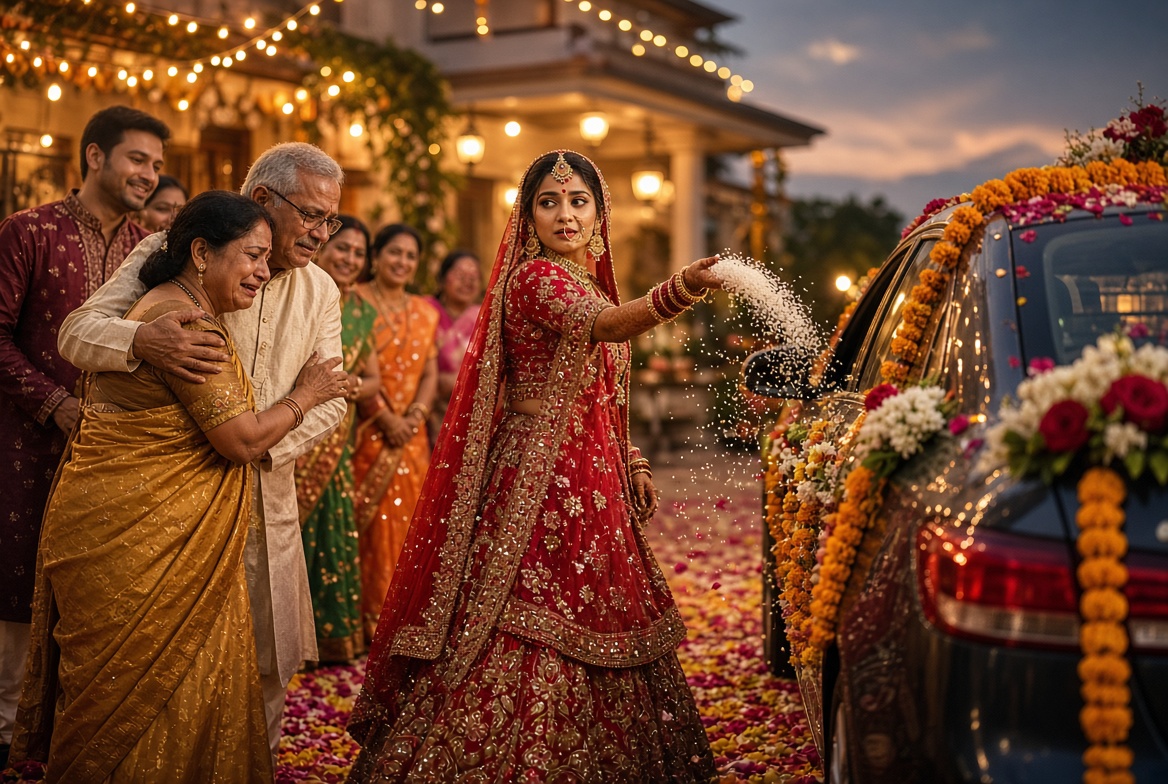
The vidai is the moment an Indian wedding stops being a celebration and becomes something else entirely. The music quiets. The bride, who has been laughing and posing for photographs all week, turns to leave her parents’ home — and almost everyone in the room starts crying at once.
If you have been invited to an Indian wedding, are marrying into an Indian family, or are planning your own and want to understand what this ritual actually means, here is what happens and why.
Vidai (विदाई), also written as bidaai or vidaai, simply means “farewell.” In Muslim weddings the equivalent ceremony is called rukhsati. It marks the bride’s formal departure from her parental home to her husband’s.
Historically this was literal and permanent. A daughter left the household she grew up in and joined another, sometimes in a different village, with limited contact afterward. Modern weddings have changed the practical reality enormously — most brides will see their parents next week — but the ritual has kept its emotional weight. It is a farewell to a version of life, not just to a house.
The sequence varies by region, community, and family, but most North Indian vidai ceremonies include some version of the following.
The rice throwing. The bride is given handfuls of rice, sometimes mixed with coins. She throws them backward over her shoulder without looking. The gesture is understood as repaying her parents for everything they gave her, and as a wish that prosperity remains in the house even after she leaves it.
The walk to the car. Traditionally the bride left in a doli, a covered palanquin carried by relatives. Today it is nearly always a decorated car. Her brothers, cousins, and sometimes her father walk her out.
The goodbye. This is the part nobody plans and nobody forgets. The bride embraces her mother, her father, her siblings. Fathers who have been composed all day frequently are not. There is no script.
The departure. The car pulls away, often with brothers walking alongside it or briefly pushing it. Family members may follow to the gate.
Arrival and griha pravesh. At her new home the bride is welcomed with her own ceremony, typically involving her stepping over or knocking down a vessel of rice at the threshold.
Vidai is most emotionally central in North Indian and Punjabi weddings. South Indian traditions handle the transition differently and often with less emphasis on the departure itself. Bengali weddings have their own farewell customs. Muslim families observe rukhsati, which follows a similar shape with different religious framing.
If you are attending a wedding and are unsure what to expect, ask someone in the family. Nobody minds being asked, and every family does it slightly differently.
Certain songs are so associated with vidai that they trigger the emotion on their own — older Hindi film songs about a daughter leaving her father’s house are still played at weddings decades after they were written. Many families now choose their own, and increasingly couples build a personal playlist rather than defaulting to tradition.
The hardest version of a vidai is the one where the people who raised the bride are watching from another country.
For families split across India, the Gulf, the UK, Canada, and the US, this is common rather than unusual. A grandmother who cannot travel. An uncle whose visa did not come through. Cousins who could not get the time off. The ritual is built around the idea that everyone who loves the bride is in the room, and increasingly they are not.
Some families now collect video messages from absent relatives beforehand and play them during or after the vidai — so the bride hears from her grandmother in Lucknow even though her grandmother could not make the flight. Folksee is built for exactly this: share one link, everyone records from their own phone, and every message lands in one reel the bride can watch on the day and rewatch for years. Contributors sign in with Google or an email address. It takes a few seconds, and there's nothing to install.
The vidai is about being sent off by everyone who raised you. When some of them are eight time zones away, that is worth solving.
Why we made Folksee
People deflect love when you say it to their face. A reel takes the room away, so it finally lands — and it's the opposite of doomscrolling.
Read what Reels with Feels means →


Everything works best in your phone’s browser. Tap below to open Folksee in Chrome/ Safari.
