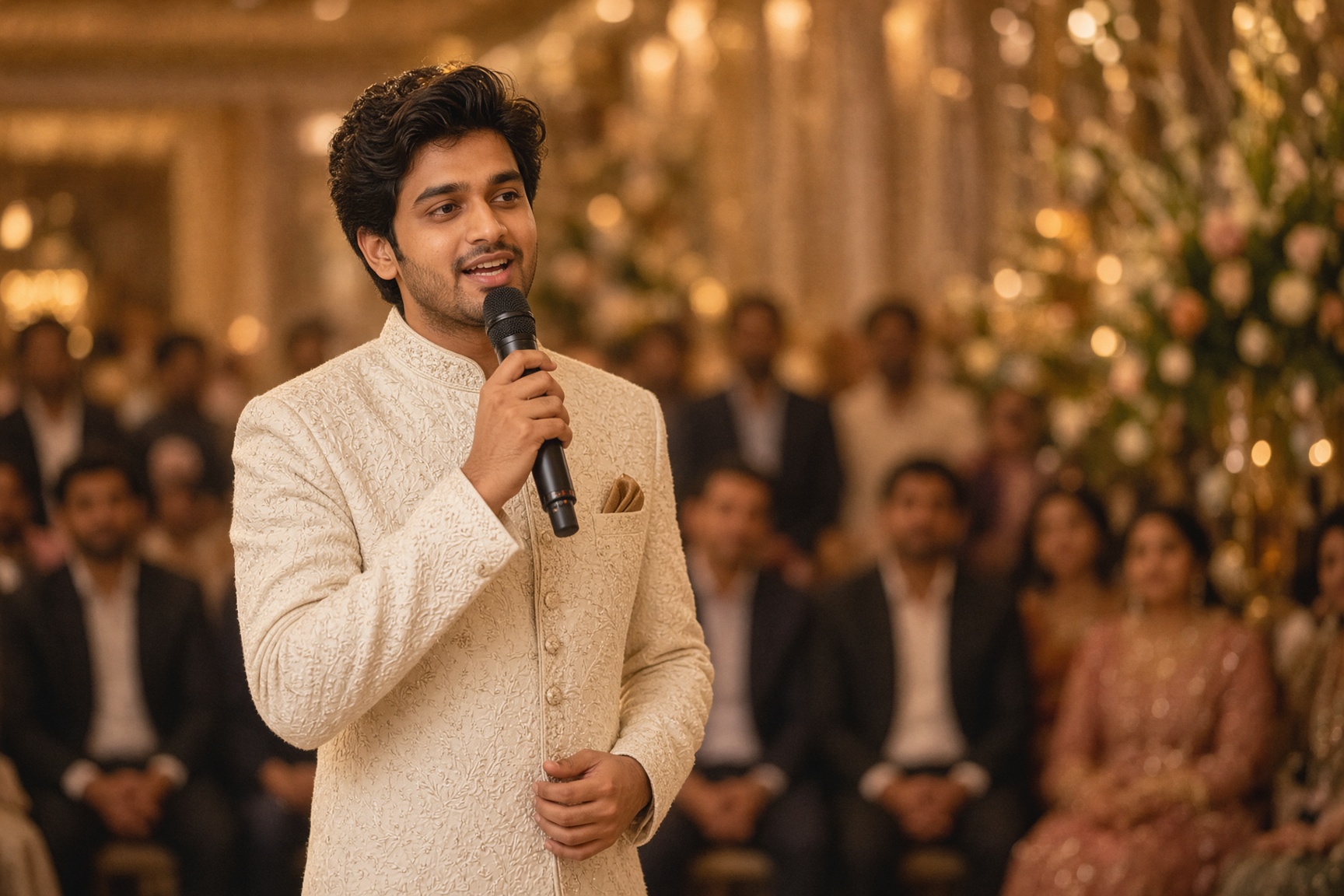
At a Western wedding, the best man gives the speech. At an Indian wedding, it is usually a sibling — and the dynamic is completely different. You are not the groom’s friend making jokes. You are family, speaking about family, in front of both families, several of whom will have opinions.
Here is how to write one that works.
Where the Speech Actually Happens
Unlike Western weddings, where speeches sit predictably at the reception, Indian wedding speeches move around:
- At the sangeet, between performance blocks. Most common, and the loosest audience.
- At the reception, more formal, larger crowd, both families present.
- At the engagement or roka, smaller and more intimate.
- Before the vidai, rare and very heavy. Only if you are certain.
Ask which one you are doing before you write. A sangeet speech and a reception speech are not the same speech.
The Structure
- Introduce yourself in one line. Both families are present and half of them do not know you.
- One specific story. Not a résumé of your sibling’s life. One moment that reveals who they are.
- Say something real about the marriage. This is where a sibling speech beats a friend’s speech — you have watched them across years, not just at parties.
- Welcome the other person in, by name. In an Indian wedding this is not optional. Two families are joining, and you are speaking for yours.
- A short blessing or toast.
Four to six minutes. Longer and you lose the room, especially at a sangeet where people want the dance floor back.
Brother of the Bride
Openers:
- “I have spent twenty-six years being the less impressive sibling, and today she has made it official in front of four hundred people.”
- “My sister has never once let me win an argument. [Groom], I want you to understand what you have signed up for.”
- “I was told to keep this short and not embarrass anyone. I can promise one of those.”
The turn:
- “She was the one who covered for me. Every time. Our parents still do not know about most of it.”
- “I have watched her decide exactly who she wanted to be since she was about nine. She has never once wavered. That is the person you are marrying.”
- “[Groom], the thing about my sister is that she does not need protecting. She needs someone who knows that. I think you do.”
Closers:
- “You are not losing a sister. I have been told this is the line I am supposed to say. I do not believe it and neither does my mother, but here we are.”
- “Go be happy. Come home often. Bring food.”
Sister of the Bride
- “Half my childhood is standing up there in a lehenga.”
- “People keep telling me I am gaining a brother. What I am actually losing is someone to blame things on.”
- “She has been my first phone call for every good and bad thing that has ever happened to me. That is not changing today, whatever anyone says.”
- “[Groom], she will let you think you are making the decisions. You are not. None of us are. Welcome.”
Brother of the Groom
- “My brother has made exactly one good decision in his life and she is sitting right there.”
- “Growing up, he broke everything I owned. Somehow he has grown into someone genuinely careful with the things that matter.”
- “I have never seen him nervous about anything until the day he told me he was going to propose.”
- “[Bride], thank you for taking him seriously. Most of us never have.”
Sister of the Groom
- “I have been told the sister of the groom does not usually give a speech. I have also been told I talk too much, so here we are.”
- “He was the annoying one. He is still the annoying one. But he is also the one who called me every single day when I was going through the worst year of my life.”
- “[Bride], you have made him better in ways I did not think were available. Genuinely. Thank you.”
What Works Differently at an Indian Wedding
Both families are listening. A joke that lands with your siblings may not land with your new in-laws’ extended family. Judge the room you will actually have, not the room you wish you had.
Respect forms matter. Refer to elders appropriately. This is noticed.
Do not roast the other family. Gentle teasing of your own sibling is expected. Anything aimed across the aisle reads badly, however affectionately intended.
Language. Mixing Hindi, Punjabi, Gujarati or Tamil into an English speech is normal and welcome. Forcing pure English often makes it stiff. Use whatever your family actually speaks.
Expect to be interrupted. Indian wedding crowds are participatory. Someone will shout something. Roll with it.
If You Cannot Be There
Siblings miss weddings more often than people admit — visas, work, distance, cost. If that is you, a recorded speech is a genuine substitute rather than a consolation.
Record it properly: somewhere quiet, phone propped up, one or two takes, under three minutes. Say the thing you would have said standing there, including that you should be standing there. The honest version lands harder than the upbeat one.
If several people are in the same position, collecting the messages together works better than sending files individually. Folksee does this with one shared link: everyone records from their own phone, and the messages play back in order as one reel at the sangeet or reception. Contributors sign in with Google or an email address. It takes a few seconds, and there's nothing to install.
Practical Notes
- Write it down. Do not memorise it. Know your beats, keep a card.
- Practise out loud twice. It will run longer than you think.
- Pause after the laugh. Let people actually laugh.
- If you cry, keep going. Nobody minds. Everyone else is crying too.
- End clearly. “Raise your glass” or a simple blessing. Do not trail off.
For more on structure and delivery, our guides to father of the bride speeches and best man and maid of honour speeches cover the mechanics in more depth.